How to know if your shadowing session actually worked
Two simple checks that catch the difference between real progress and weeks of treading water — record yourself, and use the keep-up test.
5 min read · Apr 30, 2026
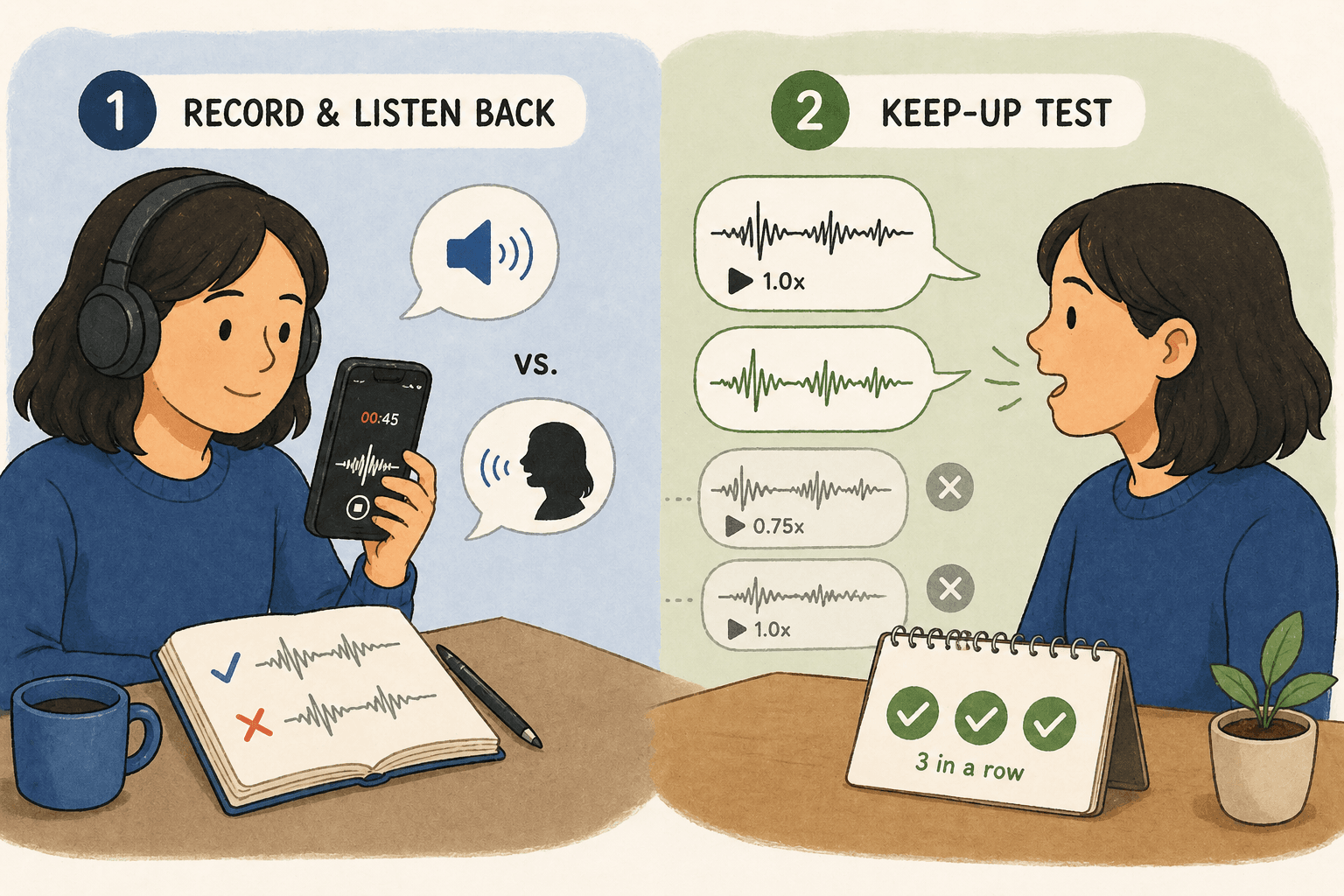
Shadowing is a quiet exercise. You don't get scores. Nobody grades you. Some days it feels like you're just talking to yourself in the dark — which makes it hard to know if you're actually getting better, or just running through the motions.
You need two simple checks: one tells you if a single session worked, the other tells you when to move on from a clip. Both take almost no time and they're the difference between weeks of progress and weeks of treading water.
Check #1 — Record yourself, listen back
The catch with shadowing is that you can't hear yourself accurately while you're doing it. Your inner ear fills in the gaps. You think you matched the speaker; you didn't. You think your th was clean; it wasn't. The only way to know is to record and play it back.
- During a shadowing session, hit record on your phone's voice memo app. Just leave it running.
- Pick one or two clips where you really tried. Find your recording at the same timestamp.
- Listen to the original clip. Then listen to your version immediately after. Same speed? Same rhythm? Same stress on the same words? Or did you slow down, flatten out, smooth over the hard sounds?
It's uncomfortable. The first time you do this, you'll cringe — your voice sounds different on a recording, and the gap between what you thought you produced and what you actually produced will be obvious. That gap is the most useful piece of information you'll get all week. Every flaw you can hear is a flaw you can fix.
You don't need to do this every session. Once a week is enough. The point isn't to grade yourself; it's to catch the patterns where you're cheating without noticing — slowing down, swallowing endings, dropping consonants you can't produce yet.
Check #2 — Can you keep up at full speed?
The other question is when to retire a clip. People stay on the same clip too long because it feels productive (familiar feels like progress) or they ditch it too early (they confuse one good run for mastery). Here's the cleaner test:
If you can only do it cleanly at 0.75× speed, you're not done. If you can do it at 1× but only by rushing past the hard consonants, you're not done. If you nailed it once on a lucky run, you're not done. Three clean runs at full speed is the bar. It's deliberately demanding because anything less means the pattern hasn't actually locked in yet.
Most clips will take 4–8 reps over a couple of sessions to reach this. Some will take a week. A few will fight you for longer — usually the ones with sounds your native language doesn't have. Stay with those longer; the resistance is the practice.
What to do with the results
- Recording sounds like the original? You're ready for harder material. Pick a faster speaker, a different accent, or a noisier real-world clip.
- Recording sounds slower or flatter than the original? Stay on the same level of difficulty for another week. The fix isn't harder content; it's tighter execution on what you already have.
- Specific sounds keep failing? Find clips that feature those sounds heavily. Don't avoid them — that's how the gap stays in your speech for years.
- You can't hold the sentence in your head long enough to repeat it? That's a working-memory load, not a pronunciation issue. Drop to shorter clips for a week, then build back up.
The honest part
Most learners never check. They shadow for months, vaguely feel like they're improving, and quietly plateau. The two-minute cost of recording once a week and applying the keep-up criterion is the difference between hoping you're getting better and knowing you are.