What MRI scans show shadowing actually does to your brain
A 2020 controlled trial scanned 119 brains before and after 4 weeks of shadowing. Three findings worth knowing — and one honest caveat about what shadowing won't do in a month.
8 min read · Apr 30, 2026
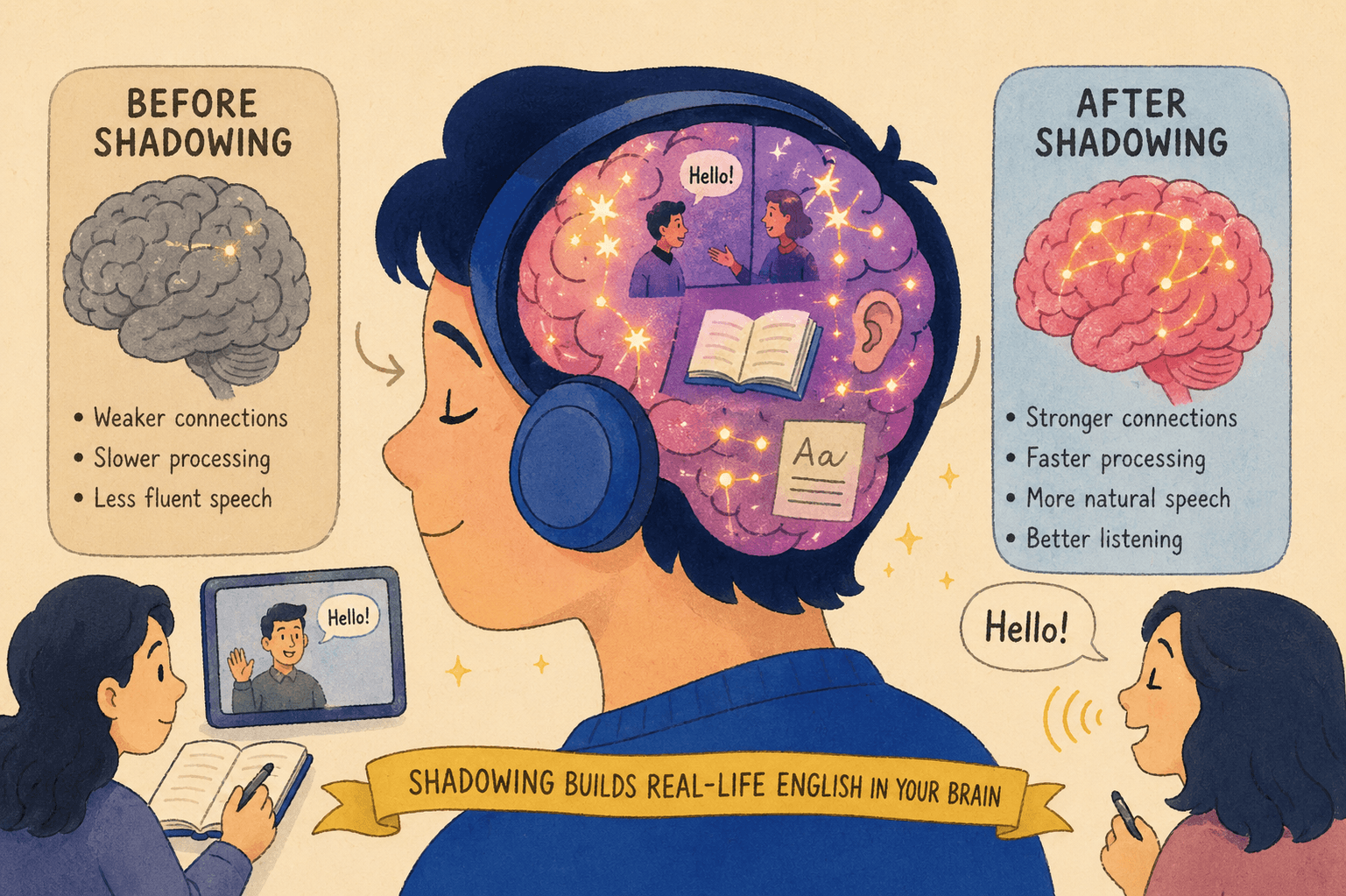
Most language-learning advice is anecdote dressed up as science. “Polyglots swear by it.” “A famous linguist said so.” That's fine, but it's not evidence. So when researchers actually run a controlled trial with brain scans before and after, it's worth paying attention.
In 2020, a team led by Hikaru Takeuchi at Tohoku University did exactly that. They put 119 young adults through 4 weeks of intensive English training, scanned their brains before and after, and tested working memory. Four groups: one shadowed, one read English aloud, one listened to compressed (fast) English without speaking, and one was a control. Here's what they found, and what it means if you're trying to use shadowing to get fluent.
Speaking is the active ingredient
The two groups that spoke — shadowers and aloud-readers — improved their working memory measurably more than the two groups that only listened. They were faster on a cognitive task called the 2-back, and trended toward higher digit span (how many random numbers you can hold in your head).
The listen-only groups got essentially none of this benefit, even the group that was forced to listen at fast (compressed) speeds. This matters because plenty of learners reach for “just listen to more podcasts” as their main practice. Listening does train your ear. But on the cognitive machinery that underpins fluent speech, hearing English without producing it moves the needle very little. Producing it does.
The brain literally becomes more efficient
This is the most striking finding. After 4 weeks of shadowing, the shadowers' brains used less gray matter and less activation in a specific region (the left cerebellum) to do the same working-memory task. Reading-aloud showed the same pattern in a different but related region (the right anterior insula).
That sounds backwards — shouldn't practice make brain regions more active? But this is actually the signature of a skill becoming automatic. When you first learn to drive, the whole brain lights up; after a year, you're using a fraction of the resources for the same task. Both regions in the study are part of the “phonological loop” — the system that holds words in your head and re-articulates them, which is exactly what's being trained when you shadow.
Translated to plain language: shadowing teaches your brain to process speech with less effort. That efficiency is what fluency feels like from the inside — words coming out without you having to consciously assemble them. The study showed the transition starting after just 4 weeks.
Reading aloud is a real complement
Most articles treat shadowing as the only useful technique. That's not what the study found. Reading English aloud, as fast as you could while still understanding, produced gains in the same neural family — through a different region, but the same underlying system.
This is good practical news. Sometimes you can't shadow: you're in a quiet office, you're on a flight, your audio source is bad. Reading aloud is a workable substitute. Even better, the two together hit the phonological loop from two different angles, which is probably better than hitting it from one.
How fast? In the study, the reading-aloud group was pushed to read as fast as they could while still passing a comprehension check. If you can read aloud at full natural-conversation speed without slowing, the level is too easy. If you can't finish a sentence without your eyes overtaking your mouth, slow down. The right zone is the edge of your control.
The honest caveat
Here's what the study did not find: 4 weeks of shadowing didn't significantly improve scores on the actual English exams (the TOEIC reading and listening tests). That sounds bad until you look at what it's actually saying.
The benefit was to working memory — the cognitive machinery that holds language in your head while you produce it. It's the bottleneck that makes you freeze in conversation: you know the answer, but by the time your mouth is ready, the moment's gone. Working memory is what closes that gap. It's also slower to translate into a higher exam score than memorizing 200 vocabulary words is, but it's far more useful for actual speaking.
So if you do shadowing for a month and your IELTS score is the same, don't panic. The wins are happening in places exams aren't great at measuring — your ability to listen, hold, and produce English in real time.
What changed in 4 weeks
The training in the study wasn't casual. Subjects shadowed every day, with the speed adjusted upward whenever they could keep up. They started averaging 0.92× of normal speech speed — slightly slower than natural — and finished at 1.59×, well above natural conversation speed. That's a 70%+ jump in 4 weeks.
The lesson here isn't the specific numbers — your starting point will depend on your level — but the principle: you have to keep raising the difficulty. If you stay at the speed where you're comfortable, the curve flattens. The shadowing groups that improved were forced upward continuously. The active control group that practiced something safe and unrelated didn't improve.
What this means for your routine
- Shadow most days. Speaking is what produces the gain. Listening alone isn't enough.
- Push the speed. If today's clip feels easy, tomorrow's should feel harder. Adaptive difficulty is what drove the brain changes.
- Add reading aloud on days you can't shadow, or as a second short session. It hits the same system through a different door.
- Don't expect a 4-week test-score miracle. You're building the machinery, not memorizing answers. Trust the indirect path.
- Stick with it for at least a month before deciding if it works. The brain changes the study saw needed that long to show up.
Source: Takeuchi, H., Maruyama, T., Taki, Y., et al. (2020). Effects of training of shadowing and reading aloud of second language on working memory and neural systems. Brain Imaging and Behavior. PMC8286220.