What is shadowing? (And why your tongue feels stuck without it)
A two-sentence definition, the difference from listening and repeating, and a 3-minute exercise you can try right now.
5 min read · Apr 30, 2026
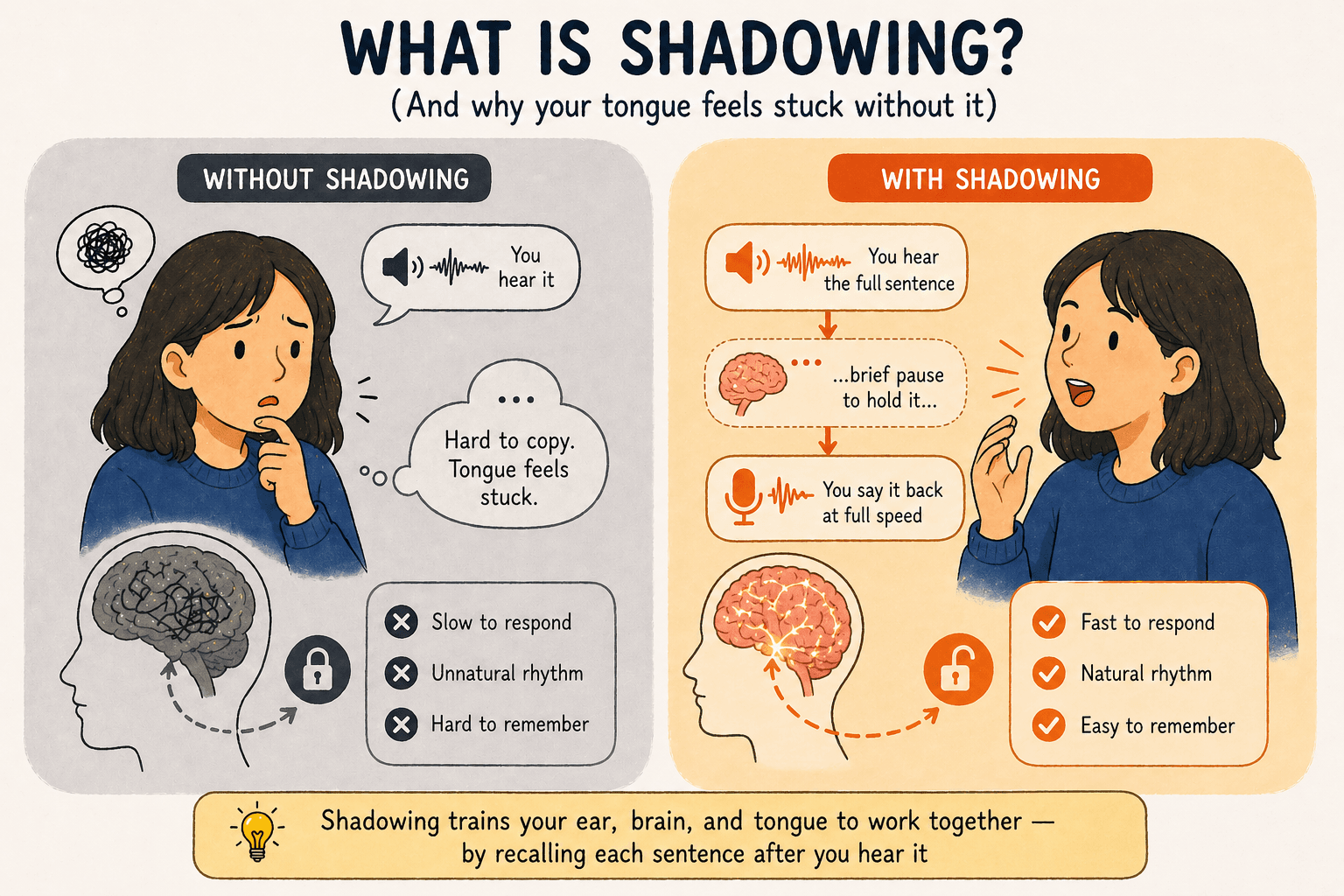
Shadowing is when you listen to someone speaking and repeat what they said back at the same speed they said it. The trick is when you start: you wait until the speaker finishes a sentence (or a chunk of one), hold it briefly in your head, then deliver it at full speed in the gap.
That small delay is the whole point. It forces your brain to recall English under time pressure and your mouth to produce it at natural speed — which is exactly what fails you in a real conversation. After enough reps, the recall stops being effortful and you start sounding like the person you're copying.
Most learners do it wrong without knowing
Shadowing is essentially the same idea as “repeat after me”: you hear something, you say it back. What separates a useful session from a wasted one is one tiny detail — when you start speaking.
There are two ways to do it. Most learners pick the wrong one because it feels easier.
- Speaking on top of the audio. You start talking the moment the speaker starts, trying to keep your voice overlapping with theirs. You can do this all day without getting tired, because nothing is being asked of your memory — you're just echoing sounds as they arrive. It feels like shadowing. It mostly isn't.
- Speaking after the audio. You let the speaker finish a full sentence first. You hold the sentence in your head for a moment. Then, in the silence right after, you say it — at the same speed they did. This is the version that builds fluency, because now your brain has to recall a real English sentence on demand and your mouth has to deliver it under time pressure. That's exactly the skill that breaks down when someone asks you a question in real life.
Same exercise on paper, completely different workout. A good way to check yourself: if a 15-minute shadowing session leaves you relaxed, you were probably doing the first version. The right version is mentally tiring — recall is hard work, and that's the point.
Two close cousins of shadowing also won't get you fluent on their own. Passive listening trains your ear but never your mouth. Reading dialogues aloud moves your mouth but doesn't train your ear or your recall — you can see the next word coming. Shadowing, done with that small delay, is the only one of the three that hits all of it.
Why your tongue feels stuck
If you've ever known the right word but couldn't say it smoothly, that's a motor problem, not a knowledge problem. Your tongue, lips, and jaw haven't practiced the shapes English actually uses — the consonant clusters, the unstressed syllables that get swallowed, the way did you becomes didja.
Shadowing builds those shapes by repetition. Every time you mimic a native speaker, you're training the muscles that produce the sound. After enough reps, the shapes become automatic, and you don't have to think about them mid-conversation.
Try it right now (3 minutes)
- Find a podcast clip in English. Anything 1-3 minutes. A YouTube video works too.
- Listen once with no shadowing. Just understand what they're saying. Don't worry about every word.
- Play it again. After each sentence ends, pause for half a second, then say it back at full speed. Don't start while the speaker is still talking — let the sentence finish, hold it in your head, then deliver it. If you can't remember the whole thing, just say what you got and move on.
- Play a third time and notice where you stumbled. Those spots are your weak patterns. Repeat just those few seconds, 3-5 times.
That's it. You just shadowed properly. If you do this 15 minutes a day for a month, you'll hear yourself improving.