Why shadowing makes you fluent faster than grammar drills
Most learners can read English but can't speak fluidly. Here's the gap shadowing closes — and what it actually trains.
6 min read · Apr 30, 2026
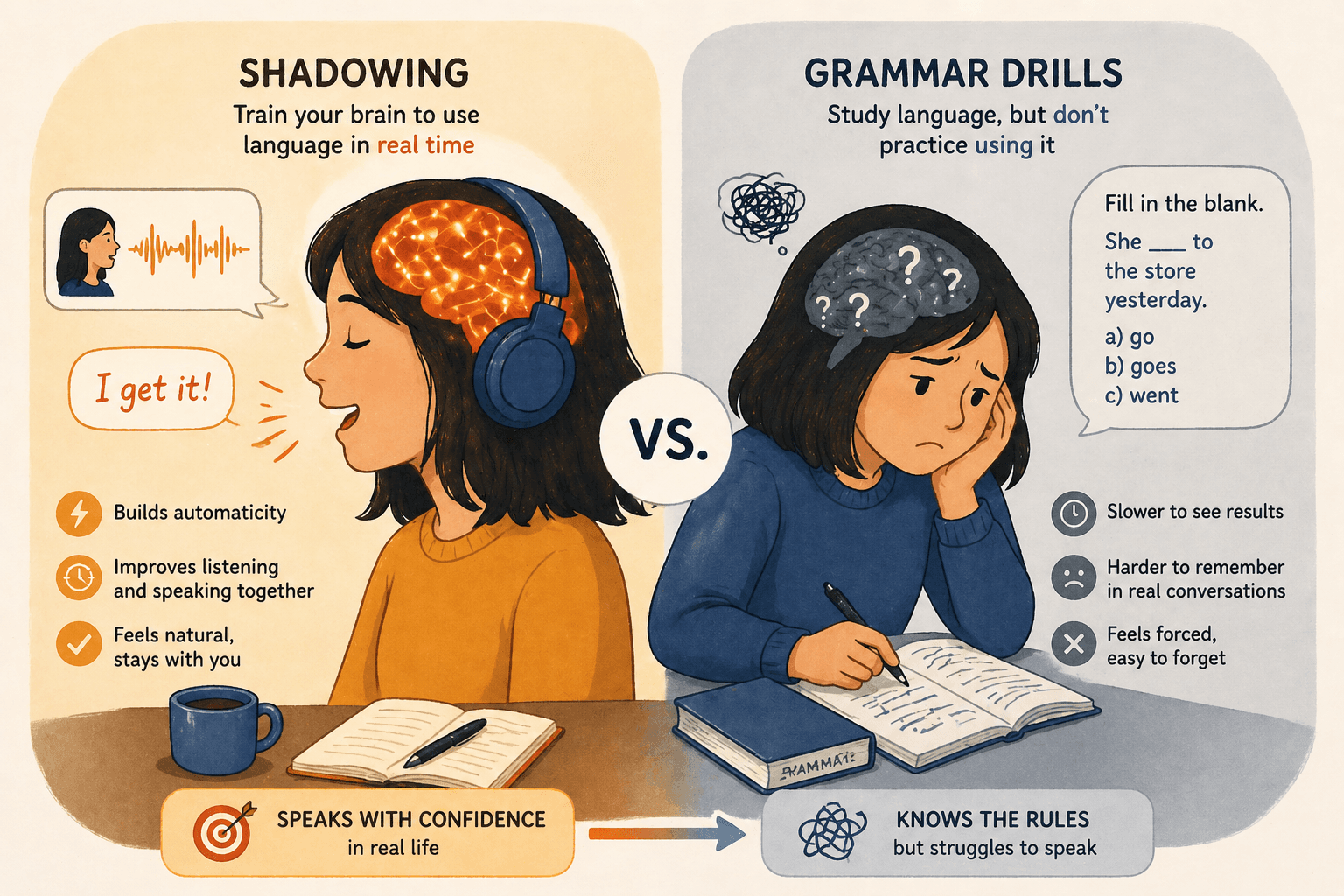
Most English learners hit the same wall. They can read articles. They understand most of a movie. They've passed exams. But when a stranger asks them a simple question, the words come out broken, slow, awkward — and they know it.
That's the input-output gap, and it's the single biggest reason fluency takes years longer than it should.
The mismatch problem
Traditional study is mostly input: reading, listening, watching, memorizing vocabulary. Input is necessary. But input alone never produces output. You can listen to a thousand hours of English and still freeze when it's your turn to talk.
The brain stores language two ways. One is the recognition system — when you hear or read a word, you know what it means. The other is the production system — when you need a word, your mouth can find it and pronounce it. These systems are separate. Training one barely trains the other.
Grammar drills are the same trap. You can know the rule for past perfect inside out and still hesitate every time you need to use it in a real sentence, because knowing a rule isn't the same as producing it under time pressure.
What shadowing actually trains
Shadowing is the rare exercise that hits four skills in parallel:
- Pronunciation — your mouth practices the exact shapes a native speaker uses. Vowels, consonant clusters, the things textbooks gloss over.
- Rhythm and stress — English isn't spoken at a steady pace. Some words get stressed, others get crushed. You can't learn this from a textbook. You have to feel it by repeating real speech.
- Linking — in real speech, words physically join together. Did you becomes didja, going to becomes gonna, what are you becomes whatcha. This is one of the biggest reasons learners can read English but can't understand it spoken — the words on the page aren't the words you hear. Shadowing forces you to produce the linked version yourself, so your ear stops getting tripped up by it.
- Chunking — natives don't build sentences word by word. They use ready-made phrases (by the way, I was just about to) as single units. Shadowing burns these chunks into your motor memory.
- Listening — you can't shadow what you didn't catch. Forced to hold a full sentence in your head before saying it back, your ear sharpens fast. After a few weeks, audio you used to find blurry starts to feel slow.
Why it's faster than what you've tried
Studies on motor speech learning suggest that producing language out loud — even when you can't do it well yet — is what builds the production pathway in the brain. Reading silently doesn't. Listening alone doesn't. You have to actually speak, repeatedly, in patterns that match how natives speak.
Shadowing is the most efficient way to do that, because every sentence the speaker says becomes a sentence you have to recall and produce yourself. There's no waiting for a teacher to call on you. There's no translating in your head. The native speaker sets the model; you re-speak it at the same speed in the gap right after.
The honest tradeoff
Shadowing is harder than passive listening. It's exhausting at first, because you're trying to do something your mouth isn't ready for. That's the point. The discomfort is the signal that you're building the muscle that you've been missing.
Fifteen focused minutes of shadowing beats two hours of casual Netflix. Pick clips slightly above your level, listen to each one in full, then say it back at the same speed in the silence right after. Over weeks, not months, you'll catch yourself speaking faster and more naturally than you ever did with grammar drills alone.